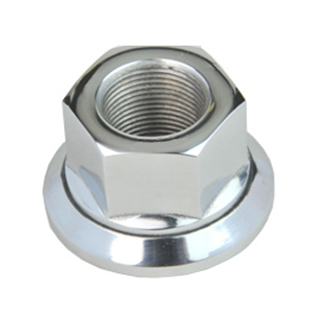
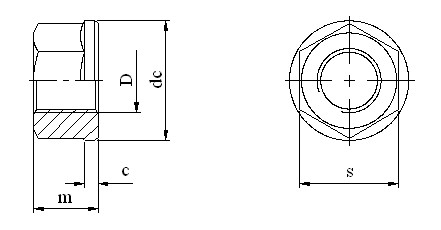
Bolts and nuts fastening methods are widely used in connection with parts of the design of mechanical equipment. Because of low cost and flexible installation, this connection gets wide range of applications. But this connection will occur automatically fall off when the device is experiencing severe vibration, resulting in fastener failure and equipment failure. Many of the major quality accidents are caused by the small fasteners loose.
To solve the problem, many scientists and engineers used a variety of auxiliary locking approaches such as washers, chemical glue, pins, locking plate, nylon lock, physical deformation, etc., but those Methods can only play a temporary solution to the problem, do not solve the problem from the root –loose.
The locking principle of thread fasteners is the key to the structure of the shape of the thread. American engineers studied the structure and the forces of thread fasteners, and redesigned the geometry of nut thread, invented this variant thread which is now called 30° variable tooth type locking thread, a fundamental solution to the problem of the loose of fasteners.
30° variable tooth type thread has a unique anti-loosening screw thread structure, the tooth bottom of the female thread has a wedge slope of 30 degrees, when tightening the bolt clasp nut to each other, the cusp of the bolt tightly press on 30° wedge ramp of the variable tooth nut , resulting in a lot of petty clamping force. Since the variable in the angle of the tooth shape, the direction of the method force produced by the contact between bolt and nut and the axis of the thread is angle of 60 degrees, instead of 30 degrees of common thread. This thread form makes the method pressure of 30 °variable tooth type thread is far greater than the fastening pressure, so the friction generated by the method pressure greatly add. Meanwhile, when thread engagement happens between the crest of the male thread and the female thread of 30° tooth type locking thread, the prongs of the crest appears to local elastic deformation, in which the load is evenly distributed on the contact line length of the coil (see Figure 1), avoiding the phenomenon of more than 80% of the total load is concentrated on the surface of the thread of the first and second teeth as common standard thread engagement. Therefore, the thread coupling Vice of 30° variable tooth type locking thread not only overcome the shortcomings of coupling Vice of the ordinary standard thread easy loosening under vibration conditions, but also greatly extend the life of the bolt.

NASA and a number of research institutions have done the research on 30° variable tooth type locknuts, they used (JUNKERS) vibration test machine to do the lateral load vibration test, showing that it has a very excellent vibration capability (Figure 2 three kinds of nuts contrast). They tested three basic nuts: 30° variable tooth type locknuts, ordinary standard nut and effective torque locknuts. They do the test on the same testing machine using the same standard bolt, the same amplitude frequency, the same tightening torque load, the test time was two minutes. The results are that all the ordinary standard nut loose; effective torque locknuts have lost 70 percent of locking capability; while 30° variable tooth type locknuts remained above 75% of residual axial force, and verify its reliable self-locking capability.
On the basis of the above experiment, repeated use of the three threads for further lateral vibration test: after tooth nut torque wrench to tighten and loosen repeatedly, 30° variable tooth type locknuts still does not reduce the locking force, maintaining the original nut locking effect, which proves that it can be reused; after a few moments tightening and loosen, the locking force of the general standard nut and effective locknut continues to decrease until the complete loss of lock ability, proving that they can not be reused.
In China, the Shanghai Zhengao (ZG) commissioned by China Machinery Industry General Parts Product Quality Supervision Center done lateral load vibration test for its production of 30° variable tooth type locknut with Anbuneike lateral vibration testing machine. Test results show that 30° variable tooth type locknut has a strong locking capability for high loads, severe vibration and shock occasions. Experimental details see below "test report" (CITA pass word No. 101884).

Figure 2 The contrast of the three kinds of nuts

(1) Diesel engine
Operating temperature of turbocharger and exhaust manifold and other parts of the diesel engine is high. When they are operating, there is intense vibration. The fastening means of chemical coating and nylon locknut will fail on the condition of high temperature. The fastening means of double nut and thrust washers is slightly better than the previous two vertical solid way, but the installation is not very easy, and the anti-loosening effect is not very good.
The special thread shape of 30° variable tooth type locknut can effectively overcome the above weaknesses. It is able to withstand strong vibrations at high temperatures when tightening well. After switching to 30° variable tooth type locknut on the part of oil pipe, exhaust, pipe, turbocharger of the diesel, it effectively solves the problem of nut loose at high temperature. At present, some well-known diesel engine manufacturer such as Weichai Power, have adopted the 30° variable tooth type locknuts in these areas, locking effect is very reliable.
(2) Engineering machinery
Because of the high engine power of engineering machinery and the strong impact load when it working which will cause strong vibrations, the common thread form of bolts and nuts will fall off on their own in such a strong impact vibration. In order to prevent the failure of fasteners caused by the vibration, fastener manufacturer has taken many anti-loosening measures, such as: chemical coating, nylon nuts, crushed nuts, preset torque nut ', etc. These methods play a certain locking effect, but they have three common weaknesses:1)repeated use is poor, and some is even one-time, or less than 5 times;2) the installation and maintenance is inconvenient, loading and unloading the nuts need to go through several processes, and the work cost is very high;3) the chemical coating will pollute the environment, and construction workers may also cause occupational injuries. Using 30° variable tooth type locknuts, the locking effect is better, and loading and unloading the nuts is very convenience. It can be repeatedly used and do not pollute the environment, so it gradually applies to the key parts of the engineering machinery. In present the following parts of engineering machinery are using 30° variable tooth type locknut:
Crane: steel connections, gear box, trolley tracks, spreader, cabinet and other parts.
Excavators: spit broken hammer, rotary support, caterpillar band.
Mixer: bracket, reducer base, tugs and other parts.
Vibratory Rollers: universal joint of engine, the couplings.
Dozer: caterpillar band, bucket, chassis.
Loader: powertrain, chassis.
(3) Car
In China auto companies have begun to extensive use 30° variable tooth type locking thread. in the car. China National Heavy Duty Truck uses the thread tap of 30° variable tooth type locking thread to process the thread holes of transmission housing of heavy truck, abandons chemical glue and lock washers, simplifies the assembly process and solves the problem of loose bolts. Through our continuous research and testing, we now succeed in providing high-quality locknut for axle to Shaanxi Hande, Guangxi Fang Sheng axles and other companies. Meanwhile, Zhengao locknuts are also used in the gear box, through shaft and other parts. At present, high vibration locknut major OEMs in the country to promote the use, using the results our customers have been recognized At present, Zhengao’s locknut are widely used in the major OEMs in the country, the using results have been recognized by our customers.
(4) Port Crane
Trolley rack, rail clips , spreader, guide plate, brakes, cable reels electric control cabinet and other equipments on port cranes are under tremendous vibration load at work, especially the front and the back girder joints are full load on lifting moment, withstanding enormous impact and strong vibration. The engineers of Shanghai Zhenhua Heavy Industries previously used the combination lock fastening method of nylon nut + strength bolts + spring washer + stopper washer + glue, but failure cases of the combination of fastener still occur. Using 30° variable tooth type locknut not only reduces the amount of use of auxiliary fasteners, but also radically solves the technical problems. Zhenhua Heavy Industries now uses 30° variable tooth type locking threaded fasteners on the key parts of crane equipment which is easy to loose in poor and vibration condition, which ensures the safe operation of the crane equipment.
(5) Railway Equipment
Chinese Ministry of Railways is the first to introduce the technology of 30° variable tooth type thread. With the successful application of this technology in railway locomotives and rail, the Ministry of Railways issued a TB / 3019 standard in 2001.
Typical parts of 30° variable tooth type locking thread technology successfully used in railway locomotive is locomotive brake systems. The brake disc and the brake pads is a group of parts within the locomotive brake systems, the braking performance directly affects the driving safety of the train. In the past using ordinary fastener connection, the locking performance is not reliable after several tests. June 2002, Nanjing, China Non-metallic Minerals Industry Corporation friction materials testing center conducted a brake test about Dongfeng 11 machine brake wheel-mounted brake discs and tablets on the brake test bench in a ratio of 1: 1. The coupling nuts of the test all used 30° variable tooth type locknut, test results proved that the friction coefficient of the test locomotive brake discs and brake pads t is stable and reproducible. Parking brake at the speed of 160km / h one time, the temperature of brake disc can reach 252 ℃, and the surface temperature of brake disc is up to 310 ℃, the entire testing process does not have a loosening of bolts and nuts. Laboratory test results and the actual results have both proved that the 30° tooth type locknut is reliable at temperatures above 300 ℃ and show excellent anti-loosening performance. 30° variable tooth type locknut is used in conjunction with standard threaded bolt, easy accessibility, can be reused more than ten times. Comparing with slotted nut, wire thread, double locking nuts and other connections, the new anti-loose way not only safe, reliable, but also easy to maintain the brake disc, you can save a lot of maintenance costs. Braking system is a key component of railway rolling stock, its working condition is very bad, the successful use of 30° variable tooth type locknut on the brake system promotes this technology widely used in railway locomotives.
Mechanical Design which is edited by Professor Peng Weisheng and published by Higher Education Press tied the 30° variable tooth type locknuts and other four kinds of anti-loose screw connection technology which are metal prestressing nuts, opposite vertex nuts, nylon nuts and spring washers to the five locking technology. Mechanical design manual published by Chemical Publishing also do description about 30° variable tooth type locking screw technology and product standards.